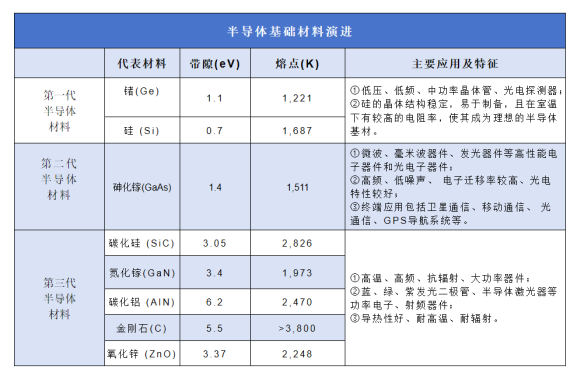
A diagram to understand the basic materials and evolution history of semiconductors
A Visual Guide to Semiconductor Base Materials and Their Evolution
I.What is a Semiconductor Base Material?
A semiconductor base material refers to the foundational material used in the manufacturing of semiconductor devices for growing crystals and preparing chips. It plays a key role in the semiconductor industry by supporting the chip structure and providing physical stability. The choice of semiconductor base material significantly impacts the performance, power consumption, and cost of semiconductor devices.
The selection of a base material depends on specific application requirements, including device type, operating environment, and performance needs. Since different base materials have distinct physical and chemical properties, it is essential to choose a base material suitable for a particular application in semiconductor manufacturing to ensure device performance and reliability.
II.The Evolution of Semiconductor Base Materials
The evolution of semiconductor base materials and the advancement of electronic technology complement each other. In summary, from the initial elemental materials to compound semiconductors and next-generation compound semiconductors, each stage of semiconductor base material evolution has been accompanied by the expansion of terminal application fields and new technological breakthroughs.
First-Generation Semiconductor Materials: Silicon, Germanium
Silicon has a stable crystal structure, is easy to prepare, and has a high resistivity at room temperature, making it an ideal semiconductor base material.The invention of the silicon transistor marked the beginning of the silicon era, and silicon gradually became the dominant semiconductor material.
Second-Generation Semiconductors: Gallium Arsenide, Indium Phosphide, Indium Antimonide, Aluminum Gallium Arsenide, Indium Gallium Arsenide, etc.
With the increasing demand for high-frequency and optoelectronic devices, compound semiconductors such as Gallium Arsenide (GaAs), Indium Phosphide (InP), etc., began to be widely used. Compound semiconductors like Gallium Arsenide, Indium Phosphide, Indium Antimonide, Aluminum Gallium Arsenide, and Indium Gallium Arsenide have higher electron mobility and better optoelectronic properties, making them suitable for high-performance electronic and optoelectronic devices.
Third-Generation Semiconductors: Silicon Carbide, Gallium Nitride, Aluminum Carbide, Diamond, Zinc Oxide, etc.
Third-generation semiconductor materials aim to overcome certain technical limitations of second-generation materials to meet emerging technological and application demands. Representative third-generation semiconductor materials include Gallium Nitride (GaN) and Silicon Carbide (SiC), which offer better electrical conductivity, high-temperature resistance, and radiation resistance. These materials are suitable for high-frequency, high-power, and high-temperature environments, and are therefore widely used in power electronics, RF devices, and other fields.